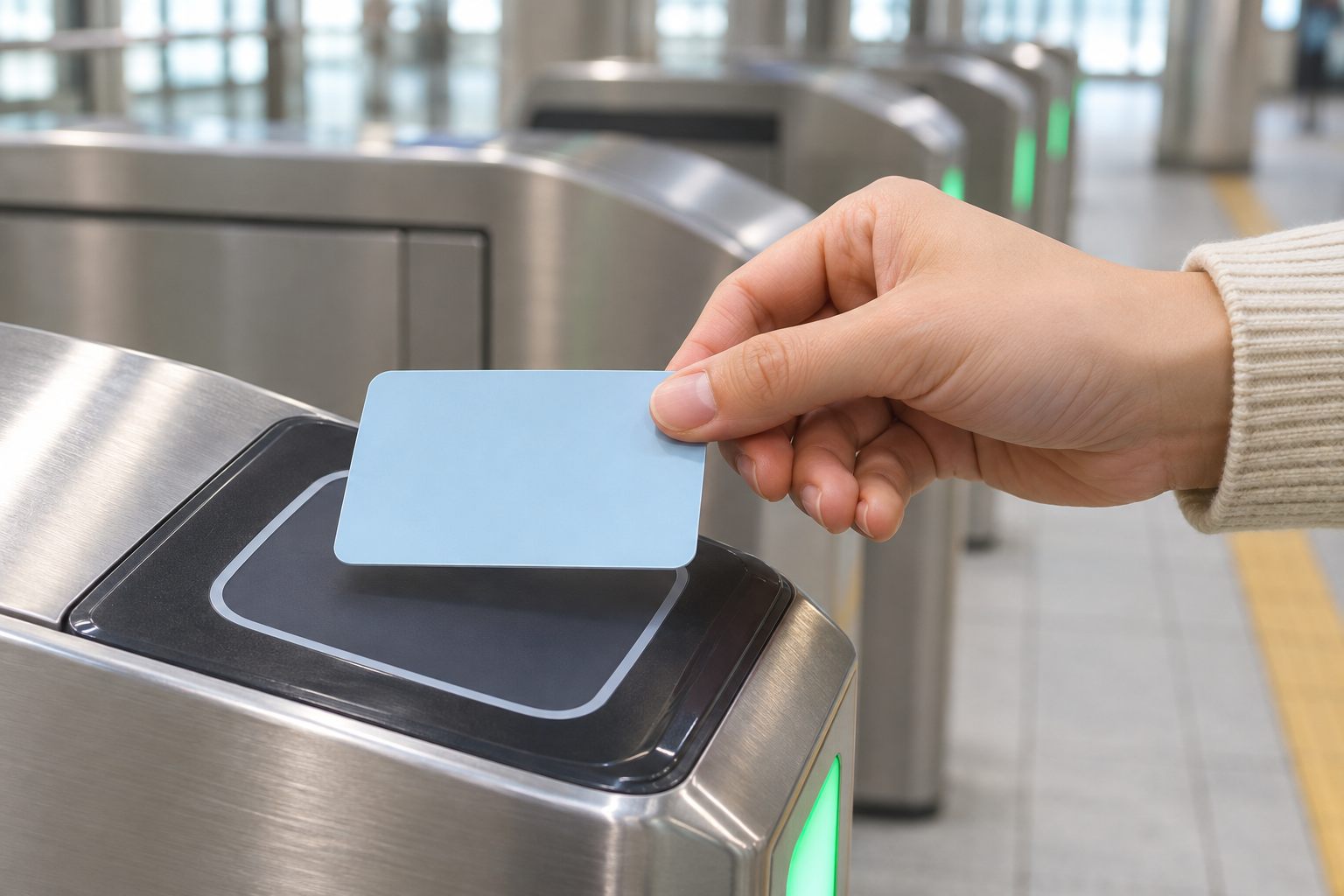
If your T-money card is not working, our suggested first steps are to take it out of your wallet, read the terminal’s message and check the balance. Treat a missing-entry warning separately from a card that remains unreadable.
Last checked: November 4, 2026
We checked official Tmoney material and public transport guidance for this article. We have not tapped a card in Korea, loaded money or requested a refund for this article.
Key takeaways
- Our suggested order is: balance, one-card reading, journey record, then possible damage.
In this guide
- Check the balance and the reader’s response
- Take one card out of your wallet
- What does “no entry tag” mean?
- Get help at the station
- Check your balance and top-up options
- If the card still does not read
- Does an old T-money card expire?
- Contact Tmoney and find language help
- If the problem is Apple Wallet or MobileTmoney
- FAQ
- Sources and what we checked
- Show staff the original card and the exact message if entry or exit remains blocked.
- Keep the card while asking about a faulty-card refund.
- Do not treat an old card as expired just because it fails to scan.
Check the balance and the reader’s response
Tmoney’s insufficient-balance FAQ says a starting ride requires at least the base fare for that service. Our advice is to confirm the balance before buying a replacement card.
Tmoney’s reader FAQ describes a circle for a normal tap and a cross for an incorrect tap on its Seoul reference readers. It also describes three beeps for an incorrect tap. We did not establish that every bus and subway reader uses this display or sound pattern.
Our suggestion: note whether you got a balance warning, a request to try again, an entry/exit warning or no response. Keep that wording for the driver or station staff instead of guessing from the beep alone.
Take one card out of your wallet
Tmoney’s multiple-card FAQ warns that presenting several transit cards together can produce extra deductions. It instructs users to remove the intended card and present that card alone.
Our suggested retry is to move your wallet away and hold the card steadily over the reader’s marked area. If the card moved during the first attempt, that alone does not identify the fault. We did not find an official physical-card rule assigning a particular error code to movement.
A Seoul city explainer from 2019 lists E-02 as a request to retry at the same position. Our advice is to follow the displayed retry instruction and ask for help if it persists. Do not keep trying different subway gates to clear an unexplained error.
What does “no entry tag” mean?
The same dated city guide lists E-04 for an entry that was not recorded, E-33 for an already-recorded entry and E-44 for an already-recorded exit. It also explains that presenting a card at an exit-side reader while trying to enter can trigger the missing-entry warning. These are historical examples, not a verified list for every current gate.
Our recommendation is to stop retapping and explain where you boarded and where the problem appeared. Keep the same card available for staff to inspect.
For buses, the Tmoney reader FAQ describes an already-processed message after a quick repeat boarding tap. Our advice is to show the driver the response and follow their instructions. Tmoney also documents using the other bus reader when one reader fails in its bus-terminal FAQ. Ask the driver before switching readers.
Get help at the station
A Seoul city column from 2016 describes using the emergency-gate call bell to request staff-assisted fare settlement. Our suggestion is to look for the marked staff-call bell beside the gate and ask staff to check your card. We did not verify every station’s current layout.
Show the card and explain whether you are trying to enter or leave. For a language barrier, our suggested request is: Please check this card and help me complete my journey. Let staff direct the next step before passing through the barrier.
Check your balance and top-up options
The Korea Tourism Organization’s 2021 card guide illustrates a remaining-balance display on bus and subway readers and a balance check after machine reloading. Its age means we would not rely on its exact screen layout today. Our practical suggestion is to ask a Tmoney top-up retailer or station staff to check your card’s balance.
Tmoney’s visitor guide documents Korean-won cash top-ups at listed retailers and station facilities. Its recharge-method guide also lists bank-transfer and restricted Woori-card channels. Those listings do not establish that your foreign bank card can reload ordinary physical Tmoney.
If you have no cash, our suggestion is to ask about an available payment option before relying on it. Confirm the updated balance before returning to the gate. For the full buying and top-up explanation, see our T-money card guide.
If the card still does not read
Tmoney’s service terms distinguish a visually intact but defective card from physical damage such as bending, cracks or chip damage. Our suggestion is to keep an unreadable card and ask Tmoney about assessment.
The faulty-card guide lists a postal-refund envelope route through partner convenience stores, including GS25, CU and 7-Eleven. You enclose the card and completed application, then send the envelope for assessment. The station submission route shown is for Tmoney service desks on Incheon subway Lines 1–2; Tmoney Town is another listed option.
The refund FAQ describes payment to the account on the application within ten business days of receipt. The service terms use a two-week period after Tmoney receives the card. We did not confirm acceptance of overseas bank accounts or immediate cash payment for a faulty card. Before submitting, ask how the refund can reach you if you are leaving Korea soon.
Physical damage qualifies for balance assessment, not repayment of the plastic card’s price. For an undamaged card that develops a fault within two years of its first top-up, the main refund guide and terms also allow repayment of the card price. Our advice is to leave the card intact while choosing a route. The separate photo-refund procedure requires cutting it and excludes the card-price refund.
Does an old T-money card expire?
Article 26 of Tmoney’s service terms allows use and refund without a validity expiry. It states a five-year limitation period from the last top-up or use, but permits use and refund beyond that when a legitimate physical card is retained and presented.
Loss is different: Tmoney’s electronic-finance terms generally treat it like lost cash, with exceptions for designated protected products. Our advice is to keep an old card and ask about a reading problem rather than assume its money has expired.
Contact Tmoney and find language help
Tmoney’s customer center lists 1644-0088 and weekday hours of 09:00–18:00. Its visitor guide directs foreign-language enquiries to Seoul’s Dasan Call Center: call 120, then press 9. We did not confirm English support on the Tmoney number itself.
If the problem is Apple Wallet or MobileTmoney
For Tmoney not working in Apple Wallet, or not adding to it, use our Apple Pay in Korea guide. Use that separate guide for MobileTmoney questions too; the steps here concern your physical card.
FAQ
Why did my T-money card suddenly stop working?
Our suggested checks are balance, one-card reading and entry/exit state before asking about damage. One failed tap does not establish which cause applies.
What should I do about a no-entry-tag warning?
Our advice is to keep the original card and ask station staff to check the journey record. Explain your starting station and the gate where the error appeared.
Can I top up T-money with no cash?
Tmoney lists some non-cash channels, but we did not establish a universal foreign-card route. Ask about your specific option before depending on it.
Does T-money expire after five years?
The terms distinguish that limitation period from validity expiry and allow continued use and refund when a legitimate physical card is presented.
Sources and what we checked
We read the linked official material on November 4, 2026. The Seoul city columns and KTO illustration are dated historical guidance; Korean explanations are our translations. Reader layouts, individual refund eligibility and actual telephone connections were not tested.