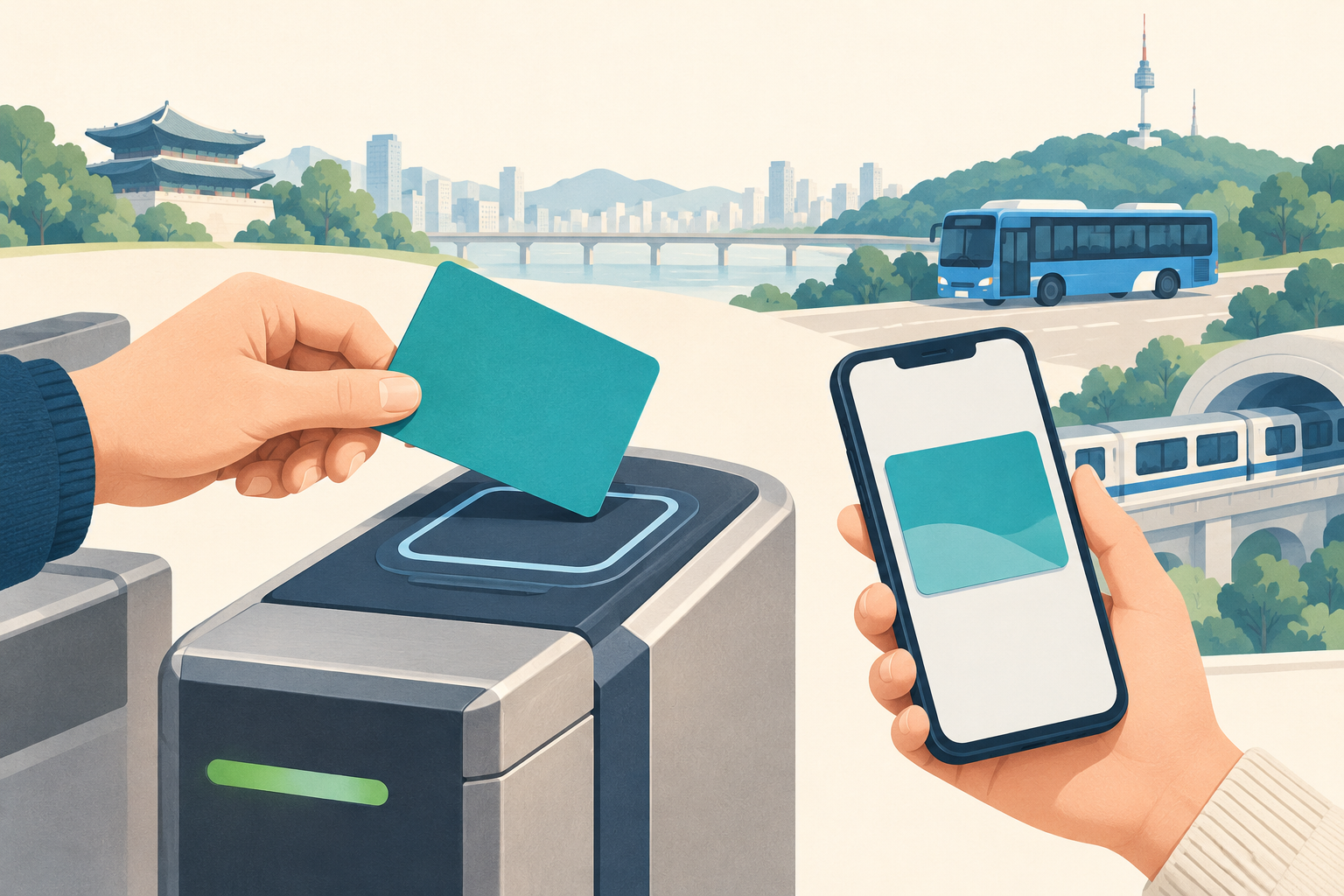
A Tmoney card in Korea can keep everyday bus and subway payments separate from phone setup. For a visitor who wants a physical card, the practical starting point is a Tmoney-selling convenience store and some Korean-won cash for the transport balance. An iPhone option also exists, but being able to use Apple Pay at home does not establish that you can fund Tmoney directly in Apple Wallet.
Last checked: October 20, 2026
We read the current Tmoney operator guides, Seoul city transfer rules and Apple support pages linked below. We have not bought, loaded, tapped, refunded or added a card to a phone for this article. Store stock, actual payment acceptance and your phone’s eligibility need checking before you rely on them.
Key takeaways
- Buy the card and add transport money as separate steps; check the price of the design you choose.
- Korean-won cash is a documented walk-up top-up route, not proof that every Tmoney channel is cash-only.
- For Seoul-area transfer discounts, use your own card and tap both when boarding and leaving.
- Direct Tmoney funding in Apple Wallet requires a South Korea-issued credit or debit card, according to Apple.
- Keep the physical card: loss, damage, leftover balance and an old unused card are different problems.
In this guide
- Choose the physical card or phone route first
- Buy the card, then add your transport balance
- Top up with a method you can actually use
- Tap correctly and keep the same card for transfers
- Check Apple Wallet funding before skipping a physical card
- Decide what to do with leftover money before departure
- Keep an old card; do not treat loss like damage
- FAQ
- Sources and scope
Choose the physical card or phone route first
Tmoney’s official visitor introduction describes simple physical-card use without identity documents, membership signup or an app installation. That is useful when you want to prepare for a first journey without arranging a mobile account.
Do not carry that promise over to every discount, account-based service or refund. Those can have additional conditions. This guide concentrates on ordinary physical-card preparation, with a separate phone check below.
The name on the package matters. The operator’s current tourist-card page lists TMONEY TRAVEL CARD at 4,000 won. It separately lists a 6,000-won TMONEY TRAVEL CARD + product with WOWPASS functions. The same page says the older KOREA TOUR CARD is no longer sold; existing holders retain the described partner benefits.
Those are named products, not one price for every card design. If you already have WOWPASS and want to understand its shopping and transport balances, use our WOWPASS guide rather than buying another card before checking what you have.
Buy the card, then add your transport balance
Tmoney’s purchase guide lists convenience-store chains including GS25, CU, 7-Eleven and emart24. Look for a Tmoney-selling branch, ask whether cards are in stock and confirm the price before paying. A chain name is not a live stock guarantee.
The operator also lists specified subway customer-service rooms and information centers as purchase channels. Its English visitor guide distinguishes station top-up facilities from card purchase. Do not assume every machine that reloads Tmoney sells a new card.
At the counter, keep two questions separate:
- What is the price of this physical card?
- How much money will be added for fares?
Ask the staff to confirm both amounts and the final transport balance. This avoids treating the plastic-card price as spendable fare money. Start with an amount suited to your next journeys rather than loading a whole holiday budget at once. Our Korea transport costs guide covers fare planning separately.
Top up with a method you can actually use
The operator’s recharge guide documents Korean-won cash at Tmoney-marked convenience stores, subway stations and other supported locations. Its English instructions describe presenting the card and Korean-won cash to the retailer. Supported station machines are another listed reload channel.
For the cash method, the published limit is 1,000 to 90,000 won per recharge, with up to 500,000 won stored on one card. Those are service limits, not a recommendation to carry that much prepaid money.
Keep a cash fallback. Carry enough won for your planned top-up, and confirm that the correct card’s balance increased before you leave the counter or machine. Do not depend on an untested foreign-card or phone route for the last connection of the night.
It would be wrong to turn this into “all Tmoney top-ups require cash.” The operator also documents account-transfer and restricted Korean-card routes. Its credit/debit-card section specifies Woori-issued cards at particular channels, not ordinary overseas cards. The operator’s iPhone service page also describes app functions for recharging a physical card using the phone’s NFC reader.
These descriptions do not prove that your foreign-issued card, phone, account or app version is eligible. Check the actual offered method, fee and completion instructions before depending on it. A machine advertising foreign-card payments for another transit product is not enough evidence that it can reload ordinary stored-value Tmoney.
Tap correctly and keep the same card for transfers
For metropolitan transfer discounts, Seoul city’s current rules call for one card per person and a tap at boarding and alighting. Use the same card throughout the linked journey. A missing exit tap can break the transfer chain and cause an additional fare.
The city’s rule allows up to four transfers, meaning five boardings in one linked journey. It is not a four-ride daily allowance. The usual window is 30 minutes after getting off; the overnight rule extends it to 60 minutes, with the applicable period determined by the next boarding time. The city gives the overnight period as 9 p.m. to 7 a.m. Transfers to the same route or vehicle are excluded.
Do not assume these Seoul-area conditions describe every city in Korea. Check the relevant operator if your route has a different fare system. For a group using both bus and subway, separate cards avoid relying on a special group-bus payment arrangement.
Tmoney is not a universal substitute for a reserved ticket. The operator’s transport coverage page has service-specific exceptions, including online intercity-bus booking. Check a particular airport bus or reserved train before assuming you can board by tapping. Our English train-ticket guide covers the booking route.
Check Apple Wallet funding before skipping a physical card
Apple currently supports Tmoney on eligible iPhone and Apple Watch devices. Old advice that iPhones cannot use Tmoney is therefore not a sound starting point.
The important funding restriction is narrower: Apple’s support page says purchasing or topping up Tmoney from Apple Wallet requires a South Korea-issued credit or debit card. Having an overseas card already working in Apple Pay does not remove that stated requirement.
Apple’s Korean transit page directs people who want methods other than Apple Pay to the iOS Mobile Tmoney app. That is a separate route to investigate, not proof here that every overseas Visa or Mastercard, visitor account or country setting works. We have not installed or funded the app.
Apple also says one Tmoney card is used on one device at a time. Simultaneous iPhone and Watch use requires different cards, and Wallet does not transfer balances between those different cards.
Before choosing phone-only travel, check your device and software eligibility, the funding method actually offered to you and how to recover or refund the remaining balance. Do not assume generic instructions for transferring a plastic transit card into Wallet establish that an ordinary physical Tmoney card can be imported.
Decide what to do with leftover money before departure
For a working ordinary physical card, use Tmoney’s dedicated refund table, not a rule borrowed from a different mobile or shopping product.
Its convenience-store thresholds are not identical:
- GS25: balance strictly below 20,000 won.
- 7-Eleven and the other sellers named in that row: 20,000 won or less.
- CU and emart24: 30,000 won or less.
The table describes a cash refund of the entire balance after a 500-won fee at these convenience-store channels. The physical card’s purchase price is not returned. At exactly 20,000 won, the GS25 condition is different from the 7-Eleven condition; do not round both into the same rule.
For partial refunds, the page names Tmoney headquarters and subway customer information centers, not arbitrary convenience stores. Larger balances have further conditions. Listed ATM refunds go to the holder’s account at the relevant bank; they are not a universal tourist cash-withdrawal service.
Plan the remaining balance early. If your balance is above a store’s limit, read the headquarters or other eligible channel’s requirements before making the last airport journey. For 100,000 won or more, the headquarters table describes later bank-account payment and required documents, not immediate cash for every visitor.
Physical-card and mobile refund rules differ. Do not apply a mobile percentage fee to the ordinary plastic-card store route, or assume a convenience-store refund process works for a phone card.
Keep an old card; do not treat loss like damage
Tmoney’s service terms, article 26 say its prepaid instrument can be used and refunded without a validity expiry. The following paragraph sets a five-year limitation period from the last top-up or use, but expressly permits use and refund beyond it when a legitimate physical card is possessed and presented.
That is not the same as “the balance disappears after five years.” Keep the card for a future visit and ask Tmoney about a card that no longer reads. This physical-card provision is not a promise about every digital product.
Loss is a different matter. The operator’s electronic-finance terms generally treat loss or theft of stored value like lost cash, with an exception for specifically designated protected products. Do not assume registering an ordinary card on a website insures the balance.
A card you still possess but that has stopped reading has a separate damaged-card procedure. Keep it rather than discarding it or confusing that process with recovery of a missing card.
FAQ
Can I use a Tmoney card without a Korean phone number?
The operator describes simple physical-card use without signup or an app installation. That does not establish eligibility for every phone service, discount or refund. A physical card is the route discussed here.
Can I top up with my foreign credit card?
Do not assume ordinary foreign cards work for physical-card reloads. Cash in Korean won is a documented walk-up route. Direct funding in Apple Wallet requires a South Korea-issued payment card; the separate Mobile Tmoney app needs its own eligibility check.
Can two people share one card?
For Seoul-area integrated-transfer discounts, the city specifies one card per person. Use separate cards for journeys involving subway transfers rather than assuming group bus payment rules carry over.
Does my old Tmoney card expire after five years?
The terms distinguish the five-year limitation period from a validity expiry and allow continued use and refund when a legitimate physical card is retained and presented. Keep the card; do not infer that the same rule recovers a lost balance.
Sources and scope
The linked Tmoney purchase, reload, refund, product and terms pages supply the physical-card rules. Seoul city supplies the metropolitan transfer conditions; Apple supplies Wallet and device-related conditions. We used the dedicated Korean refund table where broad summaries differ, and distinguished a five-year limitation period from expiry.
This is a preparation guide, not a record of transactions. No branch stock, machine sequence, route-specific acceptance, phone compatibility or actual refund was tested. Recheck the relevant linked page and the conditions shown to you before spending or loading money.